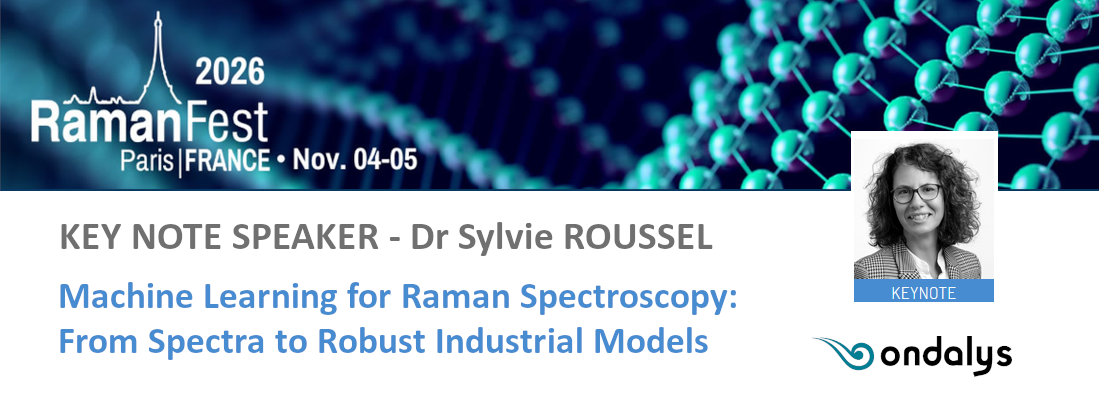


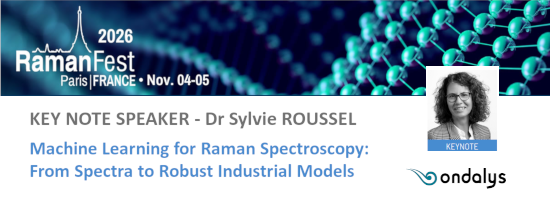
Sylvie Roussel d’Ondalys participates at the next RamanFest 2026 in Paris.
Invited keynote speaker at the event, Dr Sylvie Roussel will present a talk entitled:
Machine Learning for Raman Spectroscopy:
From Spectra to Robust Industrial Models
During this presentation, Dr Sylvie Roussel, will outline the best practices for analyzing Raman spectra using Machine Learning (ML) methods, aiming to optimize decision-making reliability in an industrial setting.
Linear and non-linear Machine Learning calibration approaches will be benchmarked for spectral data. Key comparison criteria will include predictive performance, implementation complexity, and overfitting risk. Model interpretability and the associated strategies of Explainable Machine Learning, representing a critical aspect of spectral data analysis, will also be addressed during this talk.
Finally, concrete applications will illustrate the breadth of Raman data analysis capabilities, ranging from real-time monitoring of cell cultures in biomanufacturing to Raman imaging and continuous chemical process control.
The RamanFest is the international conference on Advanced Applied Raman Spectroscopy leading international experts in Raman spectroscopy to present and discuss recent advances and state-of-the-art applications across life sciences, materials science, and energy and environmental research.
This 13th edition aims to provide the global Raman community with a place to exchange high-level knowledge, foster scientific discussion, and explore how Raman contributes to addressing current scientific and technological challenges while paving the way for future innovations.
Today, thanks to AI, developing a machine learning model from spectral data seems straightforward. On the surface, these models appear valid. But do you truly understand them? How do you interpret their results? Are you certain of their reliability and validity? Can you blindly trust a “push-button” AI solution?
With over 20 years of expertise in data analysis and machine learning, Ondalys team helps industrial companies develop spectral calibrations—and, above all, optimize model robustness and ensure reliable results.